⚔️
Fork
BeginnerA fork is when one piece attacks two or more enemy pieces at the same time. Since the opponent can only save one piece per move, you win the other.
Example
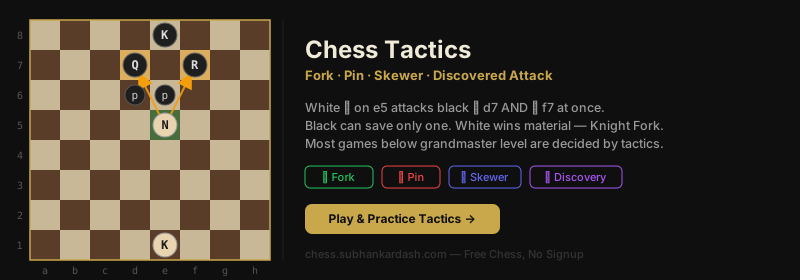
White knight on e5 attacks the black queen on d7 and rook on f7 simultaneously. Black can only save one — White wins material.
Best Piece
Knights are the best forking pieces because their L-shaped movement is hard to predict. But queens, rooks, bishops, and even pawns can fork.
Tips
- Always look for knight outposts from where a fork is possible.
- Pawn forks are extremely powerful — a pawn on d5 attacking e6 and c6 forces a major piece to be lost.
- Scan all attacked squares after your opponent's move to spot fork opportunities.
📌
Pin
BeginnerA pin is when a piece cannot move without exposing a more valuable piece behind it to capture. There are two types: absolute pins (on the king — the piece literally cannot move) and relative pins (moving is legal but costly).
Example
White bishop on b5 pins the black knight on c6 against the king on e8. The knight cannot legally move (absolute pin) — White can use it as a target.
Best Piece
Bishops and rooks create the most dangerous pins. Queens can pin along any line.
Tips
- Pin opponent pieces early in the opening — bishops to b4/b5 pinning knights is a classic strategy.
- Pile pressure on a pinned piece by attacking it multiple times.
- Break your own pins quickly: play …a6 or …h6 to chase the attacking bishop/queen.
🗡️
Skewer
IntermediateA skewer is the reverse of a pin. You attack a high-value piece (usually the king or queen), forcing it to move and exposing a less valuable piece behind it to capture.
Example
White rook on a1 attacks the black king on a8. The king must move, revealing the black queen on a5 for capture.
Best Piece
Rooks, bishops, and queens create skewers. They are common in endgames when kings become active pieces.
Tips
- Look for skewers after your opponent's king becomes active in the endgame.
- A skewer against the king often forces win of a rook or queen.
- Combine a skewer with a fork threat for a devastating double attack.
👁️
Discovered Attack
IntermediateA discovered attack occurs when moving one piece reveals an attack from a different piece behind it. The moved piece can simultaneously create its own threat, making it extremely difficult to defend.
Example
White knight on e5 moves to f7, attacking the rook on h8. This also discovers an attack by the bishop on b2 along the long diagonal targeting the queen on g7.
Best Piece
Any piece can deliver a discovered attack. Knights are especially effective because they move unpredictably.
Tips
- A discovered check is the most powerful form — the king must be dealt with first, so the other threat often goes undefended.
- Look for pieces on the same rank, file, or diagonal as enemy pieces.
- The moving piece should also create a meaningful threat of its own.
⚡
Double Check
IntermediateA double check is a discovered check where the moving piece also gives check. Two pieces simultaneously give check. The opponent's king must move — blocking or capturing won't help because both checks need to be addressed.
Example
White knight moves from d6 to f7+, giving check directly. It also reveals a bishop check on e6+. Black's king must flee — no block or capture stops both checks.
Best Piece
Any piece combination can create a double check. Knights + bishops or rooks + knights are common.
Tips
- Double check forces a king move — use it to drive the king to a worse square.
- Checkmate after a double check is often hard to see in advance — calculate carefully.
- Setting up a double check usually requires preparation over several moves.
🏰
Back Rank Mate
BeginnerBack rank checkmate occurs when a rook or queen delivers checkmate along the opponent's back rank (rank 8 for Black, rank 1 for White), with the king trapped behind its own pawns.
Example
White plays Rd8#. Black's king on g8 is trapped by its own pawns on f7, g7, h7. The rook on d8 delivers checkmate.
Best Piece
Rooks and queens deliver back rank mates. This is one of the most common checkmate patterns in practical games.
Tips
- Always keep at least one pawn escape square for your king (h3/h6 or g3/g6 are common).
- In the endgame, watch for opponent rooks lining up on the d or e file targeting your back rank.
- A queen sacrifice on the back rank can set up forced checkmate by a rook.
🌀
Zwischenzug (In-between Move)
AdvancedA zwischenzug ("between move" in German) is an intermediate move that disrupts the expected sequence. Instead of the anticipated recapture or response, a stronger move is played first.
Example
After White takes a piece, instead of recapturing immediately, Black plays a check or a winning threat. White must respond to the threat, and Black then recaptures with advantage.
Best Piece
Any piece can deliver a zwischenzug — it's a concept, not a piece-specific pattern.
Tips
- Always ask: before I recapture, is there something stronger?
- A zwischenzug check is the most powerful since the opponent must respond.
- This tactic can turn losing recaptures into winning sequences.
↗️
Deflection
IntermediateDeflection forces a key defensive piece to move away from its defensive post, allowing a mating attack or material gain. Often involves a sacrifice to lure the defender away.
Example
Black queen is the only piece defending against Qxh7#. White plays Rxd8+ deflecting the queen to recapture — and then delivers Qxh7#.
Best Piece
Any piece can be used as a deflection lure. Rooks sacrificed on the back rank are classic deflection tools.
Tips
- Look for "overloaded" pieces — pieces doing two defensive jobs at once are deflection targets.
- Combine deflection with a discovered attack or checkmate threat for a decisive combination.