Chess for Beginners —
Learn Chess from Scratch
Chess looks complex but the rules take under an hour to learn. This guide covers everything you need: how pieces move, the rules of the game, opening principles, and the most important tactics. Then play a real game online for free with our AI agent guiding your moves.
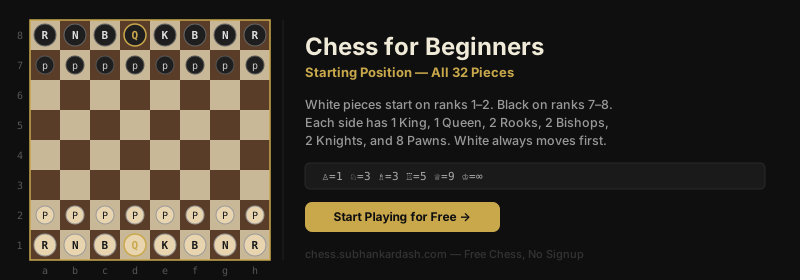
The Chess Pieces
Each side starts with 16 pieces: 8 pawns, 2 knights, 2 bishops, 2 rooks, 1 queen, 1 king.
Moves 1 square forward (2 on first move). Captures diagonally. Can promote to any piece when reaching the last rank.
Moves in an "L" shape: 2 squares in one direction then 1 square perpendicular. The only piece that can jump over others.
Moves diagonally any number of squares. Each bishop stays on squares of one colour throughout the game.
Moves horizontally or vertically any number of squares. Essential in the endgame. Used in castling.
Moves any number of squares in any direction (horizontal, vertical, diagonal). The most powerful piece on the board.
Moves 1 square in any direction. Must never move into check. Losing the king means losing the game.
Essential Rules
White moves first. Players alternate turns. The goal is checkmate — trap the opponent's king with no legal escape.
Check
Your king is in check when it is attacked by an opponent's piece. You must get out of check immediately — move the king, block the attack, or capture the attacker.
Checkmate
Checkmate ends the game. The king is in check and there is no legal move to escape. The player who delivers checkmate wins.
Stalemate (Draw)
If a player has no legal move and their king is NOT in check, the game is a draw by stalemate.
Castling
A special move: the king moves 2 squares toward a rook, and the rook jumps to the other side of the king. Only allowed if neither piece has moved and there are no pieces between them.
En Passant
If a pawn advances 2 squares from its starting position and lands beside an enemy pawn, the enemy can capture it as if it had only moved 1 square — but only immediately after the 2-square move.
Promotion
When a pawn reaches the opponent's back rank (row 8 for White, row 1 for Black), it must be promoted to a queen, rook, bishop, or knight.
Opening Principles
The first 10–15 moves set up your entire game. Follow these principles before memorising specific openings.
- 1
Control the centre
Put pawns on e4 and d4 (White) or e5 and d5 (Black). Central pawns give your pieces maximum mobility.
- 2
Develop pieces quickly
Move knights and bishops out early. Aim to develop a new piece every move in the opening. Don't move the same piece twice.
- 3
Castle early
Castle within the first 10 moves to protect your king and connect your rooks.
- 4
Don't bring the queen out early
An early queen gets chased by developing moves and loses valuable time (tempo).
- 5
Connect your rooks
After castling, clear the back rank so your rooks see each other. Rooks on open files are powerful.
Basic Tactics
Tactics are short sequences of moves that win material or deliver checkmate. Learning to spot these patterns is the fastest way to improve.
Fork
One piece attacks two or more enemy pieces simultaneously. Knights are the best forking pieces because they jump.
Pin
A piece is pinned when moving it would expose a more valuable piece behind it to attack. Absolute pins (on the king) are unbreakable.
Skewer
The opposite of a pin: a more valuable piece is attacked and forced to move, exposing a less valuable piece behind it.
Discovered Attack
Moving one piece reveals an attack from a different piece behind it. A discovered check is particularly powerful.
Double Check
Two pieces give check simultaneously after a discovered move. The king must move — blocking or capturing won't work.
Back Rank Mate
A rook or queen delivers checkmate along the opponent's back rank, trapped by their own pawns.
Use the AI Agent While You Learn
As a beginner, the best way to improve is to understand why moves are good or bad. Enable the Chess AI Agent during your game — it will suggest the best move and explain the tactical or positional idea behind it in one clear sentence.
Learn more about the AI Agent →Beginner FAQ
How long does it take to learn chess?
You can learn the basic rules in an hour. Becoming comfortable with openings, tactics, and endgames takes weeks of regular play. Becoming strong takes years — but every step is rewarding.
What is the best first move in chess?
1.e4 (moving the king's pawn two squares) is the most popular first move for beginners. It immediately controls the centre and opens lines for the bishop and queen.
How do I get better at chess fast?
Play regularly, analyse your games to spot blunders, and study basic tactics (forks, pins, skewers). Using the AI Agent in Chess Arena to get hint explanations during play is a great way to learn in context.
What is the most important piece in chess?
The king — losing it means losing the game. But the queen is the most powerful piece. Protect both, but especially develop your pieces around king safety.
Can I use the AI agent as a beginner?
Yes — it's perfect for beginners. Enable it during a game and click "Get Hint" when stuck. The agent explains the tactical or positional reason behind each suggested move in plain English.
Ready to play your first real game?
Challenge a friend online — the AI Agent will help guide your moves as you learn.