Endgame Theory

Chess Endgame Guide —
King & Pawn, Rook & Queen

Most chess games are decided in the endgame. Many players know openings well but collapse when the queens come off. This guide covers the most important endgame types — from basic king-and-pawn technique to Lucena and Philidor positions.

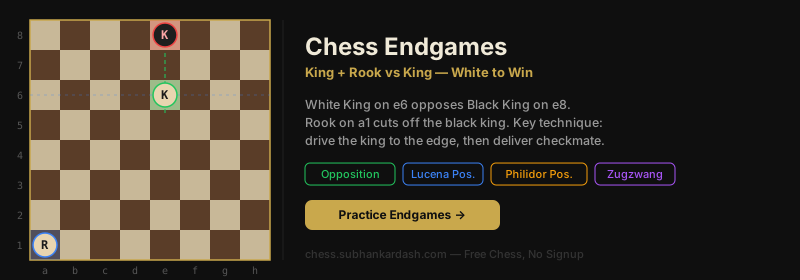
King and rook versus lone king endgame position showing opposition and rook cutoff technique

Universal Endgame Principles

👑

Activate your king

The king is a powerful piece in the endgame. Centralise it immediately — kings on e4/d4/d5/e5 are active, kings on g1/g8 are passive.

♟️

Passed pawns must be pushed

A passed pawn (no enemy pawns blocking or capturing its path) is a long-term advantage. Push it toward promotion as early as possible.

🏰

Rooks belong behind passed pawns

Place your rook behind your own passed pawn — it gains space as the pawn advances. Place it behind the opponent's passed pawn too — it restrains rather than chases.

⚔️

Avoid pawn weaknesses

Doubled pawns, isolated pawns, and backward pawns are endgame liabilities. Avoid them or create them in your opponent's position.

🎯

Zugzwang

When any move the player makes worsens their position, they are in zugzwang. This occurs frequently in king-and-pawn endgames — use it deliberately.

🔄

Triangulation

A king can "waste" a move by taking three moves to return to a square (instead of two), passing the move to the opponent and creating zugzwang.

♟️

King & Pawn Endgames

Beginner

The foundation of all endgame knowledge. If you understand K+P vs K, you understand opposition, key squares, and the rule of the square — all of which apply to more complex endgames.

The Opposition

Two kings are in "opposition" when they face each other with exactly one square between them and it is the other player's turn to move. Having the opposition means your opponent must yield ground.

Key: White king e4, Black king e6 — Black to move is in opposition. Black must go to d6 or f6, allowing White's king to advance.

Key Squares

Key squares (or critical squares) are squares that, if occupied by the attacking king, guarantee pawn promotion regardless of where the defending king is.

Key: For a pawn on e5, the key squares are d7, e7, and f7. If White's king reaches any of these, the pawn promotes.

The Rule of the Square

Draw a diagonal from the pawn's current square to the promotion square. If the defending king is inside that square when it is their turn to move, they can catch the pawn. If not, the pawn promotes.

Key: Pawn on a5, king to move. Draw a square from a5 to a8 and to d8/d5. If the Black king is inside it, it catches the pawn.

Rook Pawn Exception

A king cannot win K+h-pawn vs K (rook file pawn) if the defending king reaches the corner (h8). It's always a draw because the promoting square is a rook pawn corner — the king gets stalemated.

Key: K+a-pawn vs K: if the defending king reaches a8, White cannot avoid stalemate on many lines.

Rook Endgames

Intermediate

Rook endgames are the most common endgame type in practical chess. Even a one-pawn advantage is often decisive — but only if you know the technique. Two positions are essential knowledge.

Philidor Position (Draw)

The defending side in R+K vs R+P+K draws by keeping the rook on the third rank (cutting off the attacking king), then switching to checks from behind when the pawn advances to the seventh rank.

Key: White: Ra1, Kg6, Pa6. Black: Rb3 (Philidor position — draw). Black switches to Ra3+, Rb3+... when the pawn reaches a7.

Lucena Position (Win)

The attacking side wins by "building a bridge" — the rook shelters the king from checks using a clever manoeuvre. The king + pawn cross to the eighth rank and promote.

Key: White: Re1, Kd7, Pd6. Black: Ra8. White plays 1.Re4!, then shelters the king from checks with Re4-e5 bridge technique.

Rook Activity over Material

In rook endgames, an active rook is worth more than an extra pawn. A passive rook is the most common cause of drawing or losing won rook endgames.

Key: Always centralise and activate your rook first, even at the cost of a pawn, to create a dominant rook position.

Bishop Endgames

Intermediate

Bishop endgames split into two types: opposite-coloured bishops (strong drawing tendency) and same-coloured bishops. A bad bishop — blocked by its own pawns — is a decisive weakness.

Opposite-Coloured Bishops

When each side has a bishop covering opposite colours, the game is almost always drawn even two pawns down. The defending bishop completely neutralises the attacking bishop's pawns.

Key: Very common in practical play. Even +2 is often drawn. Avoid trading into this if you have the weaker position.

Good vs Bad Bishop

A bishop blocked by its own pawns on the same colour is called a "bad bishop". The side with a bad bishop is at a structural disadvantage.

Key: Place your pawns on opposite colours from your bishop to keep it active and mobile.

Wrong-Colour Rook Pawn

K+B+a/h pawn vs K is a draw if the bishop doesn't control the queening square. The defending king reaches the corner and cannot be dislodged.

Key: K+Bc1+a-pawn vs K: bishop is wrong colour for a8. Black king goes to a8 — stalemate or perpetual.

Queen Endgames

Advanced

Queen endgames are the most complex and counterintuitive. The defending side can often perpetually check with their queen. Even a two-pawn advantage can be drawn with correct defence.

Queen vs Pawn on 7th Rank

Usually the queen wins, except for rook pawns (a/h) or bishop pawns (b/g) where the defending king is in the corner. The queen must use a specific technique of giving check while approaching with the king.

Key: Q vs c-pawn on c2 with king on c1: White queen checks on a4+, b3+, approaches king. Technique wins. Q vs a-pawn on a2 with king on a1: stalemate traps prevent the queen from winning directly.

Queen vs Rook

Queen vs rook is a theoretical win but very difficult in practice. The defending rook can set up "fortress" positions. High accuracy required — many practical games are drawn.

Key: Force the defending king and rook to be separated. Winning requires patience and exact play — study specific positions.

🤖

AI Agent Detects Your Game Phase

The Chess AI Agent automatically detects when you enter the endgame and retrieves relevant endgame knowledge from its database — including king activation, passed pawn guidance, and rook positioning tips.

Use the AI Agent →

Test your endgame technique

Play a game, simplify to an endgame, and put these principles into practice.

Create a RoomChess Tactics Guide